Classification by Structural Form:
**Fixed Power Distribution Cabinets:** Typical models include the GGD and GCK series. These cabinets are fixed in place, have a compact structure, and are suitable for scenarios with limited space and stable loads. For example, the GGD series cabinets typically have a depth of 600-800mm and a width of 600-1200mm, accommodating multiple circuit breakers and power distribution components. They are commonly found in factory workshops and power distribution rooms.
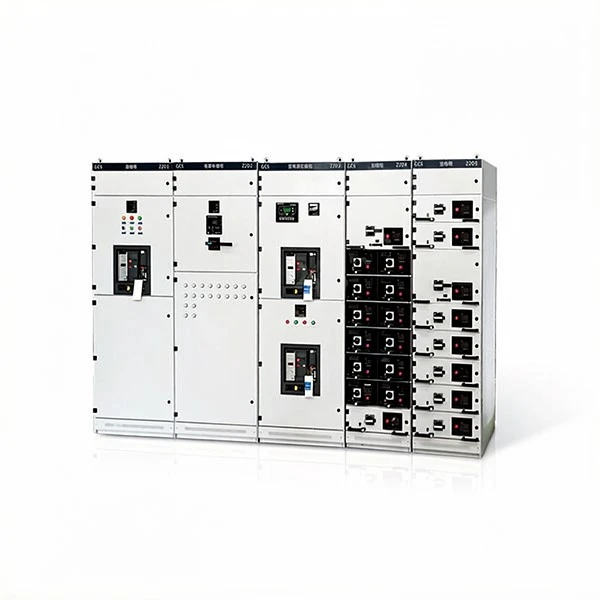
**Drawer-Type Power Distribution Cabinets:** Represented by the MNS and GCS series, these cabinets allow for independent drawer removal, facilitating maintenance and expansion. For example, the MNS cabinet has a single drawer height of 200mm and can accommodate circuit breakers up to 630A. They are suitable for scenarios requiring frequent operation or experiencing large load fluctuations, such as data centers and automated production lines.
**Modular Power Distribution Cabinets:** These cabinets utilize modular design for functional customization. For example, the XL-21 series allows for the combination of incoming, outgoing, and compensation units to flexibly adapt to different load requirements. The cabinet dimensions are customizable, with common widths of 400-800mm and depths of 600-1000mm, suitable for distributed power distribution scenarios.
Classification by Functional Characteristics:
Low-voltage Power Distribution Cabinets: Rated voltage is typically 380V/400V, covering types such as incoming line cabinets, outgoing line cabinets, and capacitor compensation cabinets. For example, incoming line cabinets require frame circuit breakers with a rated current of up to 6300A; outgoing line cabinets use molded case circuit breakers depending on the load type, with a rated current range of 63-1600A.
High-voltage Power Distribution Cabinets: Suitable for voltage levels of 10kV and above, such as the KYN28-12 series medium-voltage switchgear. They adopt a handcart-type structure and have "five-proof" interlocking functions (preventing accidental circuit breaker opening and closing, preventing the disconnecting switch from being opened or closed under load, etc.), commonly found in substations and large industrial parks.
Explosion-proof Power Distribution Cabinets: Designed for flammable and explosive environments, such as IIB/IIC level explosion-proof cabinets, the enclosure is made of cast aluminum alloy, with a protection rating of IP54-IP66, capable of withstanding internal explosion pressure without leakage. Their power range covers 32A-200A, suitable for petrochemical, grain silo, and other scenarios.
Classification by Protection Rating:
IP54 Protection Rating: Prevents dust from entering the cabinet and withstands water spray from all directions, suitable for dry indoor environments, such as office building power distribution rooms.
IP65/IP66 Protection Rating: Completely dustproof and can withstand strong water flow impact, suitable for outdoor or humid environments, such as substations in coastal areas and sewage treatment plants.
Selection Considerations:
Load Matching: Select the circuit breaker's breaking capacity according to the load type (e.g., motors, lighting). For example, if the motor starting current can reach 6-8 times the rated current, a D-type trip curve circuit breaker is required.
Environmental Adaptability: High-temperature environments require components with high temperature resistance (e.g., -25℃ to +70℃); corrosive environments require stainless steel or corrosion-resistant coated cabinets.
Expandability: Reserve 20%-30% of spare circuits for future capacity expansion. For example, with an initial configuration of 10 outgoing lines, the cabinet can be designed for a capacity of 12-15 lines.